
Thank you for Subscribing to Energy Business Review Weekly Brief


What foundational experience and philosophy shape DaKow Ventures’ operational approach today?
“Other companies may rent equipment or carry partial inventories, but they do not hold the certifications, they do not carry the fleet depth and they do not deliver the full scope. DaKow does,” says Matt Dohm, operations manager.
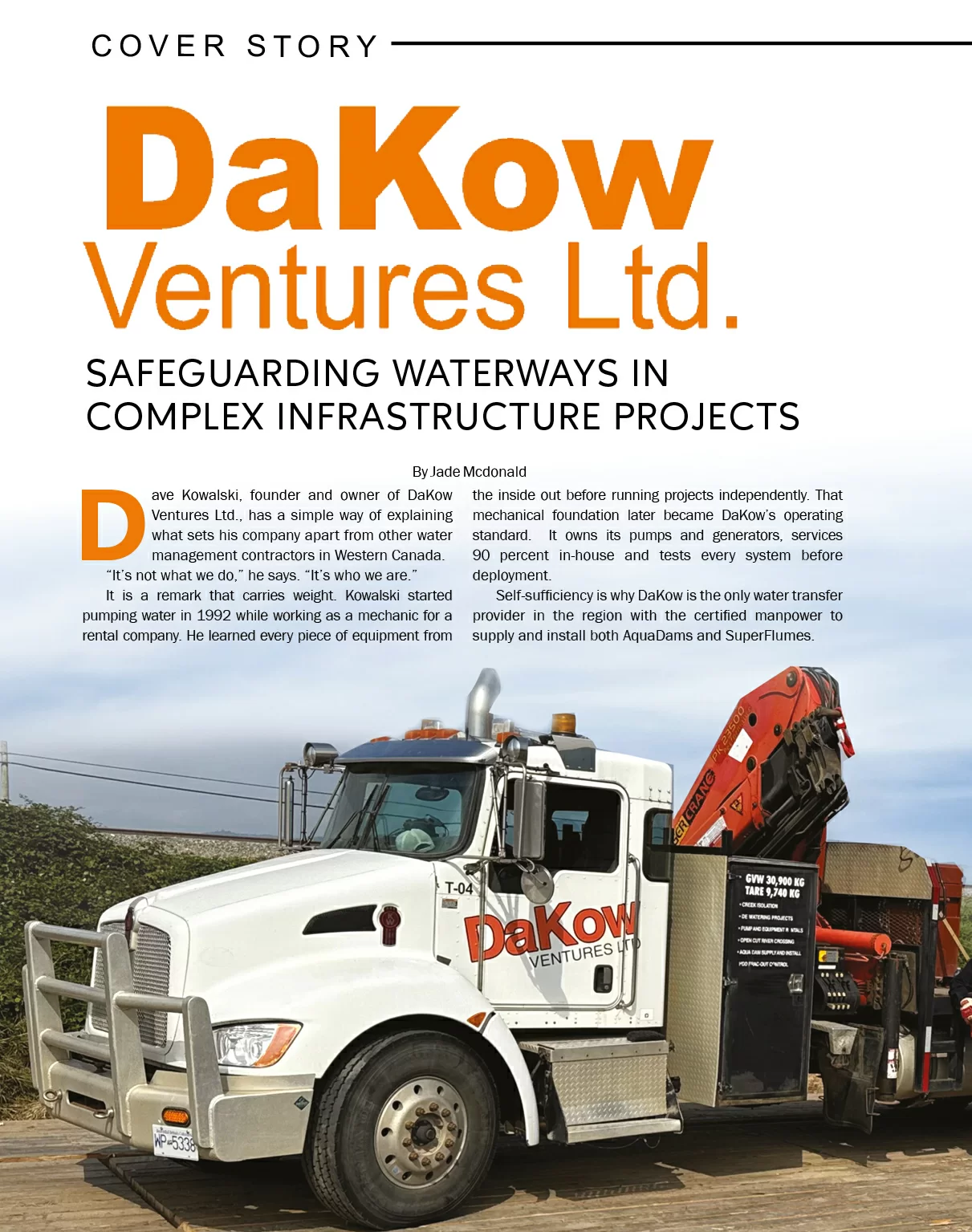
The overall rental inventory exceeds 400 pumps, supported by a comprehensive stock of fittings, pump flats, DFO cages and all supporting equipment required for water transfer. Equipment transport is handled through trucking operations in both divisions.
Dave Kowalski, founder and owner of DaKow Ventures Ltd., has a simple way of explaining what sets his company apart from other water management contractors in Western Canada.
“It’s not what we do,” he says. “It’s who we are.”
It is a remark that carries weight. Kowalski started pumping water in 1992 while working as a mechanic for a rental company. He learned every piece of equipment from the inside out before running projects independently. That mechanical foundation later became DaKow’s operating standard. It owns its pumps and generators, services 90 percent in-house and tests every system before deployment.
Self-sufficiency is why DaKow is the only water transfer provider in the region with the certified manpower to supply and install both AquaDams and SuperFlumes.
I believe in loyalty. We give it—and we earn it.
It is a genuine one-stop solution for water control on complex oil and gas, pipeline and civil construction projects. Those systems protect waterways while allowing infrastructure projects to move forward safely and in compliance with strict environmental regulations.
Operations run through two permanent, locally managed divisions. Kowalski leads the Southern division from Hope, BC. Dohm oversees the Northern division from Fort St. John. The two teams cover projects across the region and have the capacity to scale rapidly when major infrastructure programs demand it.
A Fleet Built to Perform
How does DaKow’s equipment fleet support independence and operational reliability in projects?
DaKow’s equipment inventory reflects its refusal to depend on anyone else for the tools of its trade. Its fleet includes approximately 74 diesel generators ranging from 20 kilowatts to 400 kilowatts, hundreds of submersible pumps, from 2-inch to 10-inch, thousands of layflat and suction hoses and diesel pumps with capacities of up to 10 inches. It also stocks Department of Fisheries and Oceans (DFO)-approved fish cages and SuperFlumes in both 20-foot and 40-foot sections.
Beyond the core fleet, DaKow developed specialized equipment that was new to the industry. It built its first environmental diversion support unit in 2005. These fully self-contained trailers include portable gensets, gas- and electric-submersible pumps, hoses, lighting, hand tools and every supply a crew might need at a creek crossing or a horizontal directional drilling (HDD) frac-out site.
“Select units are climate-controlled for use in harsh conditions. We currently maintain a fleet of over eight units, available with a fully staffed crew or as dry rentals for client operations,” adds Dohm.
-
We call it quarterbacking-bringing every component together so the client deals with one point of contact rather than multiple suppliers.
The overall rental inventory exceeds 400 pumps, supported by a comprehensive stock of fittings, pump flats, DFO cages and all supporting equipment required for water transfer. Equipment transport is handled through trucking operations in both divisions.
“One of our largest vendors, a firm we would normally rent equipment from, began reaching out in recent years to rent equipment from us for their own projects. That shift speaks more about our fleet depth than any inventory list could,” adds Kowalski.
One Call, Complete Coordination
Why is centralized coordination important in managing complex water control infrastructure projects?
When clients are onboarded, they quickly discover that DaKow’s process is built around simplicity. They do not have to coordinate equipment, track multiple vendors or solve logistical problems when conditions change.
 “We call it quarterbacking—bringing every component together so the client deals with one point of contact rather than multiple suppliers,” says Dohm.
If fulfilling a project requirement means coordinating five different vendors to assemble a single equipment package, DaKow will do it. The objective is always the same; remove complexity and keep projects moving.
That coordination is supported by a practical planning process that begins long before equipment reaches a job site. Kowalski frequently visits project locations himself, reviews site conditions, develops a scope of work and execution plan and provides a cost estimate based on what the job will actually require.
“He’s the guy that’s going to go out there and work with the 25-year-olds and make them look bad,” says Dohm.
That experience comes from over three decades in river diversions, creek crossings, site dewatering and HDD frac-out support. Water management projects are rarely predictable. River levels shift, access points move and installation methods often need to be adjusted in real time. With experienced decision-makers closely involved, those adjustments can be handled quickly rather than waiting for responses from distant management layers.
 The value of that coordination becomes crystal clear during large infrastructure programs.
During the peak of the Trans Mountain project, when nearly all of DaKow’s own equipment was already deployed, clients continued calling. Dohm kept the operation moving by assembling equipment packages for contractors, such as SA Energy and Ledcor, sourced from DaKow’s fleet and its supplier network.
“On some of those jobs, equipment went to the site, ran for two or three months and returned without a DaKow crew ever setting foot on the ground. The client relationship was built on that level of trust,” says Dohm.
That operating model also explains why DaKow is frequently brought into projects facing difficulties. Pipeline contractors or project owners sometimes attempt to manage water control internally, assuming it will reduce costs. In practice, that often leads to a second mobilization once site conditions prove more complex than expected. By the time systems must be rebuilt or equipment replaced, the total cost can exceed what it would have taken to involve DaKow from the beginning.
A Record of Complex Projects
In what way has DaKow demonstrated capability across complex and challenging infrastructure projects?
DaKow’s project history reflects the range and severity of the environments in which it operates. It has delivered water management systems for Site C, multiple crossings along the Coquihalla River diversion, Fraser River HDD emergency response operations, Smoky River and Pine Pass diversions and numerous creek and river crossings across BC and Alberta. Additional work has included AquaDam supply and installation, long-line water-transfer assignments and a specialty recovery project for CanPac Marine in which DaKow’s team helped raise a sunken barge from the ocean floor.
“We do what’s necessary when the job comes. We don’t walk away from a challenge. We enjoy the challenge and we do what it takes to get through it,” says Kowalski.
That mindset was tested during the catastrophic floods that struck Hope, BC. DaKow lost significant equipment on-site. Once access was restored, the team recovered what they could, brought in replacement systems and completed the project.
Those experiences have shaped lasting relationships. When Kowalski left the rental shop and went out on his own, many of his clients followed. Years later, when he sold his prior company and established DaKow, those same clients, along with many of the employees who had worked with him, followed again. One pipeline operator has worked with Kowalski continuously since 1992.
DaKow serves as a preferred water management contractor for some major energy companies. When projects involve multiple pipeline contractors bidding for work, they are often directed to engage DaKow for the water management portion of the work.
“Our business model has always been to keep the client base limited to those we can service thoroughly and well. When we take on a client, the intent is to manage their water needs completely, not one job here and there,” says Kowalski.
Safety as an Operational Discipline
Kowalski built DaKow’s safety program from the ground up, drawing on firsthand experience to bridge the gap between safety procedures on paper and safety practices in the field. It uses WorkHub to manage online training, tracking and reporting. Employees receive proper safety gear and a bi-weekly safety incentive that reinforces safe work habits. During busier periods, monthly safety awards recognize crews that demonstrate strong adherence to procedures.
The results are measurable. In 2021, DaKow’s Workers’ Compensation Board net rate stood at 2.2. By 2025, it had dropped to 1.38, placing DaKow well below the industry average.
DaKow maintains certifications through ISNetworld, Avetta, Fieldglass and ComplyWorks and operates under the regulatory oversight of the BC Energy Regulator, the Canada Energy Regulator, provincial authorities and DFO fisheries protection guidelines. AquaDam installation certification has been maintained continuously since 1992.
 A Company Culture that Endures
DaKow is not structured as a corporate hierarchy and Kowalski has no interest in turning it into one. The management group is small and many of its members have worked together for years. It operates with a family-style culture built around mutual respect, accountability and a shared commitment to the work.
That culture begins with how employees are trained.
All field training flows directly from Kowalski’s methodology. New employees are integrated into crews where experienced operators guide them through the systems and procedures that define DaKow’s standards. Crews assigned to major clients are kept as consistent as possible.
“Clients value seeing the same faces and continuity reduces the friction that comes with rotating personnel,” says Dohm.
The workforce reflects a wide range of backgrounds, genders and abilities. DaKow works with First Nations communities across BC and collaborates with certified engineering partners to meet specialized project requirements. It also supports local organizations in both regions, from the curling club and golf course in Hope to ski events and youth programs in the North.
Preparing for What Comes Next
Over the next 18 months, DaKow expects to mobilize on the Enbridge Sunrise project and is preparing for deployment on PRGT, when that program moves forward. Equipment, crews and operational processes are being positioned to enable it to respond quickly when activity accelerates.
DaKow Ventures Ltd. enters that next phase as Energy Business Review's Top Oil and Gas Pipeline Environmental Protection Service 2026, a distinction earned the same way it has earned everything else—through consistent, proven execution.
Kowalski approaches the future with the same philosophy that has guided it since its earliest days.
“I believe in loyalty,” he says. “We give it—and we earn it.”
Disciplined Water Management for Pipeline Environmental Protection
Environmental protection along oil and gas pipeline corridors has become a defining measure of execution quality for energy operators. River crossings, horizontal directional drilling programs, emergency responses and seasonal high-water events require more than rented pumps and improvised field solutions. They demand disciplined water management, documented compliance and crews who understand that diversion and dewatering are environmental obligations, not temporary tasks. Executives responsible for pipeline construction and integrity increasingly evaluate partners on their ability to control risk exposure, maintain schedule certainty and meet regulator expectations without constant oversight.
In Western Canada, oversight from bodies such as the BC Energy Regulator, the Canada Energy Regulator and the Department of Fisheries and Oceans has tightened expectations around fish protection, diversion integrity and fluid recovery. Equipment must meet DFO and provincial standards, and documentation must withstand audit. Paper compliance is not enough. Field execution determines whether a project proceeds without incident or becomes a headline. That reality places a premium on companies that own and maintain their own fleets, understand diversion methodology at a mechanical level and can respond when a job changes scope midstream.
One defining indicator of capability in this field is equipment control. Contractors that rely heavily on third-party rentals often face inconsistency in performance, maintenance history and availability. A provider that owns generators ranging from 20KW to 400KW, maintains electric and diesel pumps across two-inch to ten-inch ranges and stocks hundreds of pumps and thousands of hoses can mobilize without waiting on supply chains. Control over maintenance and testing reduces unexpected downtime. When diversion structures such as AquaDams or SuperFlumes are required, certification and inventory matter. Few water transfer firms carry both, and fewer still integrate them with dewatering, wellpoint services and HDD frac-out support under one accountable team.
Execution methodology forms the second differentiator. River and creek crossings, culvert or bridge removals and HDD support each present unique hydraulic and environmental variables. Successful firms review sites in advance, define scope and produce a clear execution plan rather than improvising in the field. When projects encounter setbacks, whether from flood conditions or underperforming prior contractors, the ability to step in, stabilize water control and complete the work without dispute is what builds preferred contractor status with pipeline operators and their prime contractors. Long-term relationships in this sector are rarely built on price alone. They are built on reliability, consistency of crews and willingness to address challenges without retreat.
"Equipment control, execution planning, and safety discipline separate reliable pipeline environmental partners from contractors built around temporary solutions."
Safety culture is inseparable from environmental performance. Firms that track training digitally, provide structured oversight and maintain competitive workers’ compensation rates demonstrate that field discipline extends beyond equipment. Incentive programs, reporting systems and in-house oversight reflect a view that safety metrics are operational data, not marketing language. In an industry where rapid scaling can strain controls, evidence of learning from prior growth cycles and strengthening administrative processes signals maturity.
Geographic presence also shapes evaluation. Permanent facilities in key regions such as Fort St. John and Hope, British Columbia provide logistical depth for northern and southern projects. The ability to establish temporary yards for multi-year pipeline builds adds flexibility without overextending core operations. Consistent crews assigned to major clients reduce retraining cycles and maintain institutional knowledge on site.
Against this backdrop, Dakow Ventures Ltd stands out as a focused environmental water management provider purpose-built for pipeline work. It owns and inventories the pumps, generators, AquaDams and SuperFlumes required for creek crossings, river diversions and HDD support, and it maintains the majority of its fleet in-house.
Its environmental diversion support units are equipped for frac-out control and fluid recovery, and its history includes large-scale projects such as Trans Mountain, Site C and multiple diversions across British Columbia and Alberta. The company pairs equipment control with boots-on-the-ground leadership, structured safety oversight and long-standing relationships with major pipeline operators. For executives seeking a disciplined, self-sufficient partner in pipeline environmental protection, Dakow Ventures Ltd represents a credible and field-proven choice.
...Read more
Company
DaKow Ventures Ltd.
Management
Dave Kowalski, Founder and Owner
Description
Dakow Ventures Ltd. is a British Columbia–based environmental and water-management specialist serving oil and gas, pipeline and civil-construction projects. With more than three decades of field experience, it delivers Aquadam installation, creek and river isolation, HDD frac-out response and site dewatering.
