

Thank you for Subscribing to Energy Business Review Weekly Brief


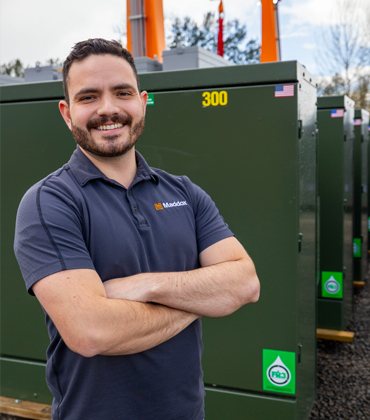 Mac Spiller, Chief Commercial Officer
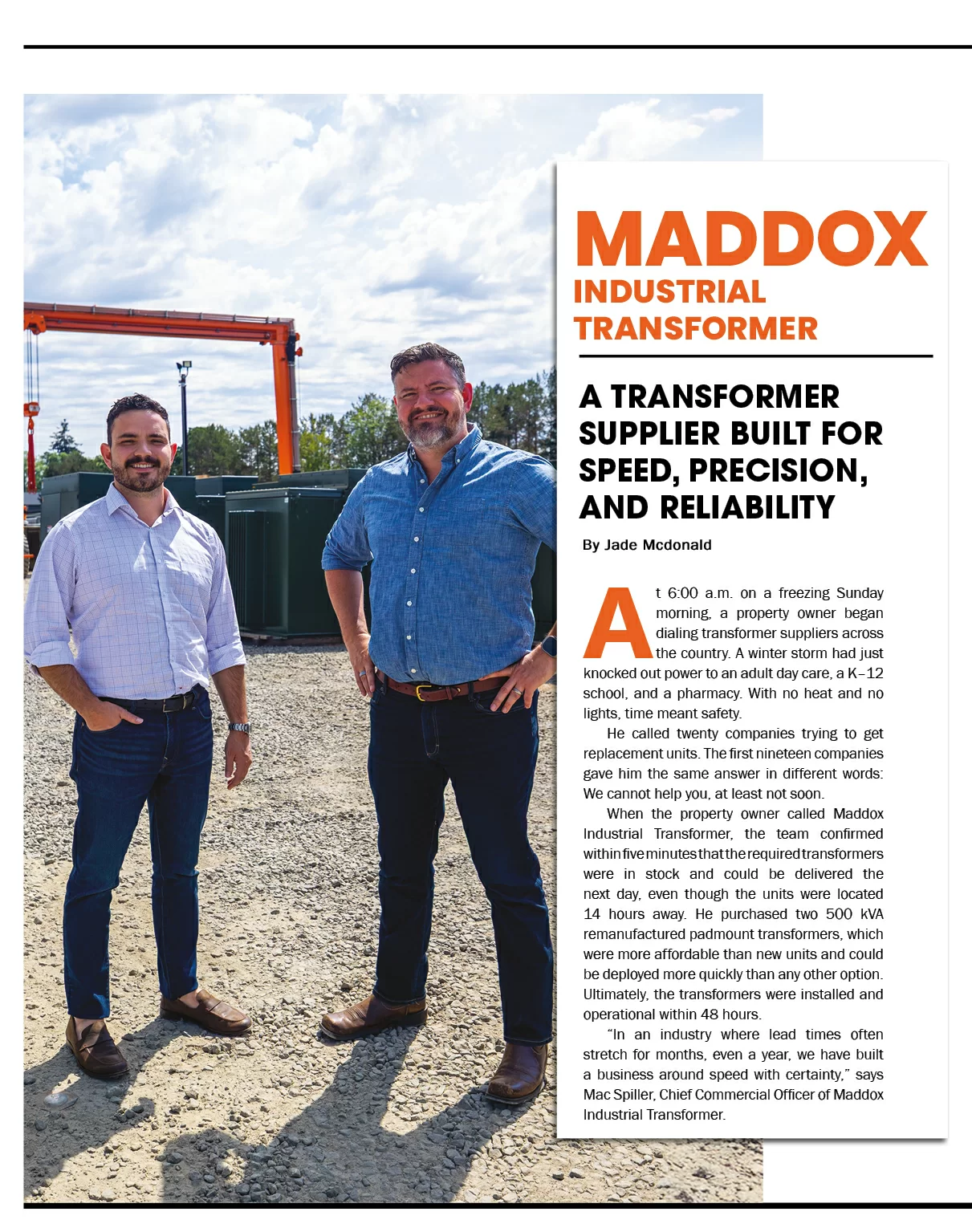
 At 6:00 a.m. on a freezing Sunday morning, a property owner began dialing transformer suppliers across the country. A winter storm had just knocked out power to an adult day care, a K–12 school, and a pharmacy. With no heat and no lights, time meant safety.
Speed, however, is not just a function of engineering. Maddox supports its operations with sales, customer service, engineering, and manufacturing teams distributed across multiple time zones, with a mix of in-house and contracted capabilities. This structure allows work to move continuously and ensures that customers are not left waiting simply because a team is offline in another region.
He called twenty companies trying to get replacement units. The first nineteen companies gave him the same answer in different words: We cannot help you, at least not soon.
When the property owner called Maddox Industrial Transformer, the team confirmed within five minutes that the required transformers were in stock and could be delivered the next day, even though the units were located 14 hours away. He purchased two 500 kVA remanufactured padmount transformers, which were more affordable than new units and could be deployed more quickly than any other option. Ultimately, the transformers were installed and operational within 48 hours.
“In an industry where lead times often stretch for months, even a year, we have built a business around speed with certainty,” says Mac Spiller, Chief Commercial Officer of Maddox Industrial Transformer.
 The company focuses primarily on the commercial and industrial (C&I) transformer market in North America, serving contractors, manufacturers, data centers, and renewable energy developers, where timelines are often tighter and delays carry immediate operational consequences. Unlike many competitors, Maddox does not prioritize large utility backlogs, allowing it to stay responsive and better support C&I customers who cannot afford long lead times.
It operates across ten product lines and offers three primary options: new transformers available in stock, new units engineered to order, and remanufactured transformers. Maddox supplies a range of transformer types, including padmount, substation, dry-type, and polemount transformers designed for commercial and industrial power systems.
The choice between these options depends on project requirements. In recent years, supply constraints have led more customers to consider remanufactured units as a faster and more cost-effective alternative. Maddox presents both new and remanufactured options side by side, allowing customers to weigh lead time, cost, and availability before making a decision.
 In addition to supplying new and remanufactured equipment, Maddox also buys surplus transformers, provides rental units, and offers repair and rewinding services. This allows customers to manage the full lifecycle of their power equipment through a single partner.
How Maddox Has Built for Speed Across the System
In practice, transformers are rarely off-the-shelf equipment; most operate in what the industry often describes as an “every unit different” environment. To manage that complexity, Maddox has invested heavily in engineering capability in recent years. Electrical, mechanical, and software engineers work alongside sales and service teams to help customers quickly determine the right solution and, just as importantly, give them clear, real-time visibility into where their order stands at any point in the process.
That level of responsiveness is supported by internal systems designed to streamline quoting and communication, allowing the team to turn around pricing and technical information significantly faster than typical industry timelines.
In an industry where lead times often stretch for months, even a year, we have built a business around speed with certainty.
In practice, that responsiveness shows up in everyday situations. Even at the leadership level, the company stays close to the work, whether that means turning around a same-day quote for a customer trying to meet a bid deadline or quickly handing the request off to a capable representative in the customer’s region. The goal is simple: no delays, no bottlenecks, and no dependency on a single point of contact.
 That responsiveness also shows up when projects begin to slip. On a project at the University of Oregon, a local electrical contractor had originally sourced transformers from another manufacturer, only to face repeated delays with no firm delivery date. As timelines tightened, the contractor turned to Maddox. The team was able to supply three new 1000 kVA padmount transformers, delivering them five months ahead of the original schedule and helping bring the project back on track.
That national footprint plays a role in both the small interactions and the critical moments, helping Maddox maintain its edge in responsiveness across the board. The company has also expanded its field service network, enabling it to respond to transformer repairs in roughly half the time typically seen across the industry. Through its nationwide network of facilities and warehouses, Maddox serves a wide range of customers, from small independent operators to large industrial projects.
 “Regardless of size, customers ultimately want the same three things: better quality, lower cost, and faster delivery,” says Spiller.
Maddox focuses on building systems that deliver on those priorities consistently. While the way those outcomes are delivered may vary by project, the underlying approach remains the same.
In many cases, that means operating with the responsiveness of a smaller company, even on large, complex projects, staying close to the customer and adapting quickly to their needs.
The Culture Behind the Consistency
Behind that approach is a strong emphasis on people and culture. In a highly competitive industry, Maddox attributes much of its reputation for consistent customer service to the way it builds its team. The company takes a highly selective approach to hiring, accepting only a small fraction of applicants each year.
Rather than hiring aggressively from within the transformer industry, Maddox has deliberately avoided a poaching model. Instead, it looks for high-potential individuals from a range of backgrounds and invests in developing their expertise internally.
-
Regardless of size, customers ultimately want the same three things: better quality, lower cost, and faster delivery.
“Our goal is to build a cohesive organization where employees grow within the company and develop a deep understanding of its values and customer-focused approach,” says Spiller.
That mindset carries through to execution. Teams take ownership of outcomes, whether that means resolving quality concerns quickly, identifying cost-effective options such as remanufactured units, or ensuring customers receive timely updates and delivery.
 The philosophy is rooted in the belief that hiring purely for industry-specific experience can lead to inconsistency over time. By contrast, Maddox focuses on identifying capable individuals, developing them, and advancing them based on performance. One example is the company’s engineering director, a mechanical engineer who joined from the agriculture industry and has since grown into a leadership role.
Bringing in talent from outside the industry also introduces fresh perspectives, allowing teams to challenge conventional approaches and rethink how quickly and effectively solutions can be delivered.
Maddox’s privately held structure allows the company to take a longer-term view when making decisions, giving teams the flexibility to prioritize customer outcomes rather than focusing solely on short-term financial metrics.
 Underpinning that approach is a clear philosophy: employees who are supported and engaged tend to deliver better outcomes for customers. Beyond competitive compensation, the company focuses on creating an environment where people have a sense of purpose, opportunities to build mastery, and the autonomy to make decisions.
That last element, autonomy, is often the hardest to implement. It requires a willingness to accept occasional trade-offs in favor of doing what is right for the customer. At Maddox, that willingness is seen as part of the company’s long-term advantage, particularly in an industry where many players are increasingly driven by short-term financial pressures.
Spiller views this approach as essential to building a company designed for long-term impact rather than short-term gains, an outlook that shapes both hiring decisions and the way the company works with customers.
Expanding Without Losing the Edge
With a focus on future growth, Maddox is continuing to expand its footprint and capabilities. The company recently opened a new office in Houston to better serve customers in that region and is developing a 40-acre site in upstate South Carolina. Additional expansions are underway in Washington State, Tennessee, and Ohio, reflecting a steady build-out of its national presence.
At the same time, Maddox’s engineering team is working on several new initiatives that are expected to further enhance the company’s offerings in the coming years. These investments are closely aligned with growing demand from data centers, infrastructure development, and industrial expansion, where speed and reliability are becoming increasingly critical.
Transformer Supplier of the Year: Meeting Industrial Demand for Speed and Precision
Electric infrastructure projects across North America are entering a period of unusual pressure. Electrification initiatives, rapid expansion of data centers, renewable generation projects and modernization of aging facilities are all placing strain on the supply of industrial transformers. Procurement leaders responsible for sourcing these assets face a complex balancing act. Equipment must arrive quickly enough to keep capital projects on schedule while still meeting strict technical requirements and budget expectations.
Transformer procurement therefore revolves around a few practical realities rather than abstract engineering ideals. Lead times remain a defining constraint across the industry. Industrial operators frequently require equipment on timelines that align with project bids, plant upgrades or new construction milestones. A supplier’s ability to deliver quickly, maintain inventory visibility and provide accurate quotations often determines whether projects move forward on schedule or stall while teams wait for equipment availability.
Technical variability introduces another layer of difficulty. Industrial transformers are rarely interchangeable components. Voltage levels, cooling methods, physical footprint and installation environments create an enormous range of configurations. Engineering support becomes critical in this environment because buyers must translate project specifications into equipment designs that will function reliably within their systems. A supplier that can navigate those variations without prolonged redesign cycles or communication gaps becomes far more valuable to project teams managing tight timelines.
Service responsiveness also carries weight long after the initial purchase order. Industrial operators frequently need support across multiple facilities or regions. National projects require suppliers that can provide engineering consultation, logistics coordination and post-delivery support without forcing customers to work through a single centralized office. Regional access to technical expertise often determines how quickly problems are addressed once equipment arrives in the field.
Cultural alignment inside the supplier organization influences these outcomes more than many buyers realize. Companies that prioritize long-term customer relationships tend to invest heavily in engineering depth, field service networks and workforce development rather than relying solely on sales throughput. Hiring philosophy, internal training and leadership autonomy shape how quickly employees can respond to customers who need information or support. Industrial buyers benefit from suppliers whose teams have the authority and technical capability to solve problems directly rather than escalating routine decisions through layers of management.
"Regional access to technical expertise often determines how quickly challenges are resolved once equipment reaches the field."
Procurement leaders also pay close attention to how suppliers balance inventory availability with custom engineering. Standardized equipment can shorten delivery timelines, yet large projects often require tailored designs. The strongest suppliers maintain a flexible structure that accommodates both needs without forcing customers into rigid product limitations. Inventory planning, engineering collaboration and field service coordination must operate in concert if buyers are to receive equipment that fits their technical requirements while still arriving on schedule.
Maddox Industrial Transformer stands out in this environment by concentrating its efforts on commercial and industrial customers across North America rather than dividing attention between industrial buyers and large utility backlogs. The company supports projects through three primary supply paths: new transformers available from inventory, newly engineered units built to order and remanufactured equipment prepared for redeployment. Each product line supports a wide range of specifications, reflecting the millions of possible configuration combinations present in modern transformer manufacturing.
Its national footprint places engineering, sales and service personnel across multiple time zones, allowing buyers to obtain quotations, technical guidance and support without long delays. Field service teams extend that responsiveness after delivery, addressing installation or maintenance concerns more quickly than typical industry timelines. Maddox Industrial Transformer complements this infrastructure with continued investment in engineering expertise and expanded facilities in regions such as Texas, South Carolina, Washington and Ohio, reinforcing its ability to support complex industrial projects at scale.
...Read more
Transformer Suppliers Info
Q1
What Should Buyers Expect from Transformer Suppliers?
Transformer Suppliers should do more than quote equipment. Buyers need clear guidance on voltage, kVA, enclosure type, lead time, installation constraints, service access and the replacement window a site can tolerate. A weak match can leave a project waiting on revisions or a facility running on temporary power longer than planned. Strong suppliers help customers compare new, engineered-to-order and remanufactured options so the final choice fits both the electrical load and the schedule.
Q2
How Does Maddox Industrial Transformer Support Transformer Sourcing?
Project delays often start when a needed unit is not available or the specification is unclear. Maddox Industrial Transformer works across ten product lines and supplies padmount, substation, dry-type and polemount units for commercial and industrial power systems. It presents new and remanufactured choices side by side, which helps customers weigh lead time, cost and availability before buying. For buyers comparing Transformer Suppliers, that breadth matters because it connects equipment type, availability and technical fit before the order is placed.
Q3
Why Do Lead Times Matter in Commercial and Industrial Projects?
Transformer delays can hold up tenant openings, manufacturing schedules, school work and backup-power planning. Long waits also force teams to revisit bids, permits and site sequencing. Transformer Suppliers that keep inventory visible and communicate status clearly reduce the guesswork around project timing. Remanufactured transformers can be valuable when they meet the specification and can be delivered faster than a newly built replacement. The practical issue is simple: power equipment usually sits on the critical path.
Q4
What Services Should Be Included Beyond Equipment Sales?
The useful scope often extends past the sale itself. Transformer Suppliers may support rentals, surplus equipment purchases, repair, rewinding and field service, depending on the customer’s need. Those services matter when a unit fails unexpectedly or when an owner wants to recover value from equipment no longer in use. A broader lifecycle approach can reduce separate vendor calls, scattered documentation and the delay that comes from explaining the same transformer history to a new provider.
Q5
How Should Customers Evaluate Quality and Fit?
The best test is a real project condition, not a polished product list. Customers should ask how a supplier confirms technical fit, handles documentation, updates pricing and responds when a delivery date changes. Transformer Suppliers also need enough engineering depth to address mechanical fit, electrical requirements and site constraints without sending every question through a slow chain of handoffs. Nameplate data, clearances, routing and service access should be reviewed before the purchase becomes a field problem.
Q6
What Makes Maddox Industrial Transformer Relevant to This Category?
Speed has to come from systems, not heroics. Maddox Industrial Transformer supports customers through engineering, sales, customer service and manufacturing teams spread across multiple time zones, helping work move even when a local contact is unavailable. It also buys surplus transformers, rents units and provides repair and rewinding services. Its expanding footprint, including a Houston office and a 40-acre site in upstate South Carolina, adds regional reach to that service model. For customers comparing Transformer Suppliers, that combination links sourcing, service and lifecycle support.
Company
Maddox Industrial Transformer
Management
Mac Spiller, Chief Commercial Officer
Description
Maddox Industrial Transformer supplies new, engineered-to-order, and remanufactured power transformers to commercial and industrial customers across North America. Serving contractors, manufacturers, data centers, and renewable energy projects, the company combines engineering expertise, large inventory availability, and nationwide operations to deliver faster lead times, flexible solutions, and reliable power infrastructure support.
